It is a deeply rooted belief in the Western political tradition, from Thomas Hobbes to contemporary interventionist currents, that a successful political community requires a strong central authority capable of imposing rules and guaranteeing order. According to this view, in the absence of such authority, society would inevitably collapse into chaos.
History, however, offers a particularly intriguing counterexample. For nearly seven centuries, the Couto Mixto, a small microterritory composed of the villages of Santiago de Rubiás, Rubiás, and Meaus, existed along the border between Portugal and Spain without a permanent sovereign or centralized governmental authority. Despite this absence of formal state power, it developed a stable social order grounded in voluntary self-government and an extensive regime of free trade.
The existence of the Couto Mixto arose from a juridical and territorial ambiguity between Portugal and Spain that was never fully resolved. This ambiguity created a space in which political authority was diffuse, power was limited, and social organization emerged primarily from custom and mutual convenience. It constituted a concrete historical example of spontaneous order, in the sense described by Friedrich Hayek, standing in contrast to the rationalist constructions of central planning.
This spontaneous order took shape through a practical and functional institutional system that entirely dispensed with the state monopoly on violence and taxation. Local administration was carried out by an Honorary Judge, or Alcaide, elected annually on a rotating basis from among the heads of households of the three villages, known as homens-bons. The judge was assisted by a council of homens-bons—one representative from each settlement—who made decisions by consensus in an assembly open to all heads of household. This arrangement constituted one of the clearest historical examples of direct democracy in Europe.
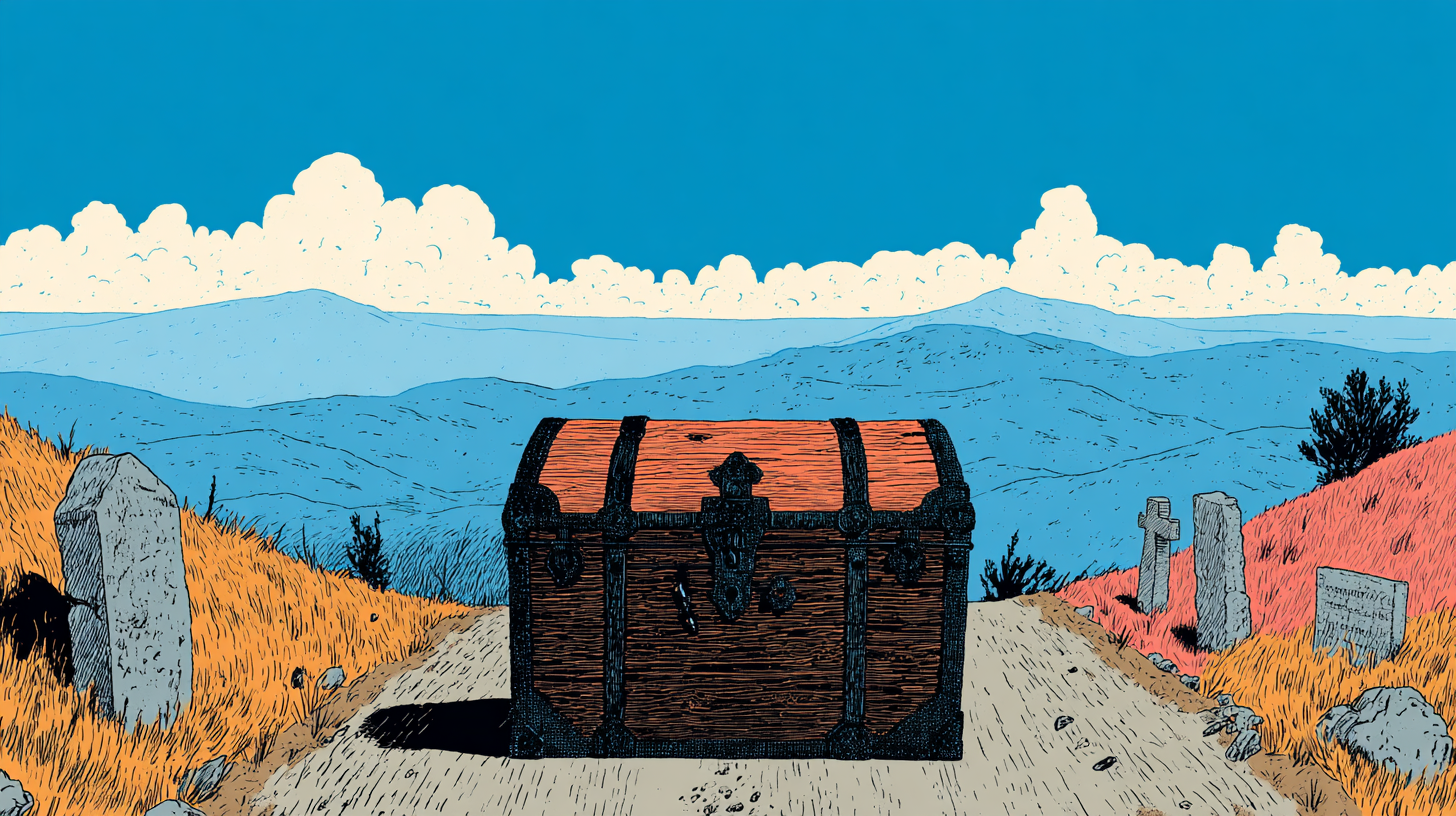
An ingenious mechanism symbolized this decentralization. Essential documents of the territory, including royal privileges, records of decisions, official seals, and communal archives, were kept in a wooden chest secured by three separate locks. Each homem de acordo, a respected representative chosen by common consent, held one key, making unilateral access impossible for any individual, including the judge himself. Opening the chest required the simultaneous consent of all three representatives, providing a practical safeguard against abuses of power and a striking illustration of voluntary checks and balances without the need for a coercive state.
There was no standing army, no state police force, and no coercive fiscal bureaucracy. Order was maintained through customary norms and voluntary cooperation. This model of radical direct democracy and extreme decentralization functioned peacefully for centuries.
Beyond its distinctive political organization, the inhabitants of the Couto Mixto enjoyed a set of privileges that would today be readily recognized as concrete expressions of classical liberal principles. They could freely own and carry arms at a time when this was forbidden to the general population. They were exempt from military service and enjoyed complete freedom to attend Portuguese and Spanish fairs and markets without paying taxes or customs duties.
The territory also preserved the right of asylum that had underpinned its original formation, preventing external authorities from entering in pursuit of fugitives, except in cases of homicide.
The economic heart of the Couto Mixto was its unparalleled regime of free trade. One of its most emblematic privileges was the Caminho Privilegiado, a road approximately six kilometers long, marked by stone boundary markers engraved with crosses, along which no state authority, Spanish or Portuguese, could search individuals or inspect goods. This immunity was not enforced through local armed power, but through a long-standing tacit recognition by neighboring kingdoms, for whom violating the privilege would have entailed diplomatic conflict, frontier instability, and political costs outweighing any immediate gains.
The physical marking of the road itself functioned as a visible juridical boundary, transforming it into a genuine neutral corridor where state authority was suspended by mutual convenience.
This protected corridor turned what mercantilist states labeled “smuggling” into legitimate voluntary exchange, illustrating in practice how free trade flourishes when direct state intervention is absent.
In a feudal and mercantilist Europe, these privileges, including total tax exemption, freedom to cultivate monopolized products such as salt and tobacco, and protected commercial routes, transformed a remote and mountainous region into a genuine enclave of economic liberty. They enabled a level of relative prosperity markedly superior to that of neighboring communities burdened by heavy taxation, monopolies, and state regulation.
Historians such as Luís Manuel García Mañá, in his work Couto Mixto: Unha república esquecida, note that the cultivation and sale of tobacco, prohibited or monopolized in neighboring kingdoms, generated substantial incomes and even permitted the formation of local fortunes. At the same time, the Caminho Privilegiado sustained constant exchanges that raised living standards in a traditionally poor agrarian area.
The autonomy of the Couto Mixto came to an end in 1868 with the practical application of the Treaty of Lisbon of 1864, which formally divided the territory between Portugal and Spain and abolished its historic privileges. Though internally successful, its existence became incompatible with the centralizing, fiscal, and territorial logic of the modern nation-state.
The Couto Mixto was not a theoretical utopia but a real, functioning society, embedded in a specific historical context, which endured for centuries and demonstrated that social order can emerge without centralized political leadership, without coercive taxation, and without an absolute state monopoly on force. Its experience does not deny the existence of the modern state, but it does call into question one of its most persistent assumptions: that central authority is a necessary condition for stability, cooperation, and prosperity.
The post The Couto Mixto was first published by the Foundation for Economic Education, and is republished here with permission. Please support their efforts.