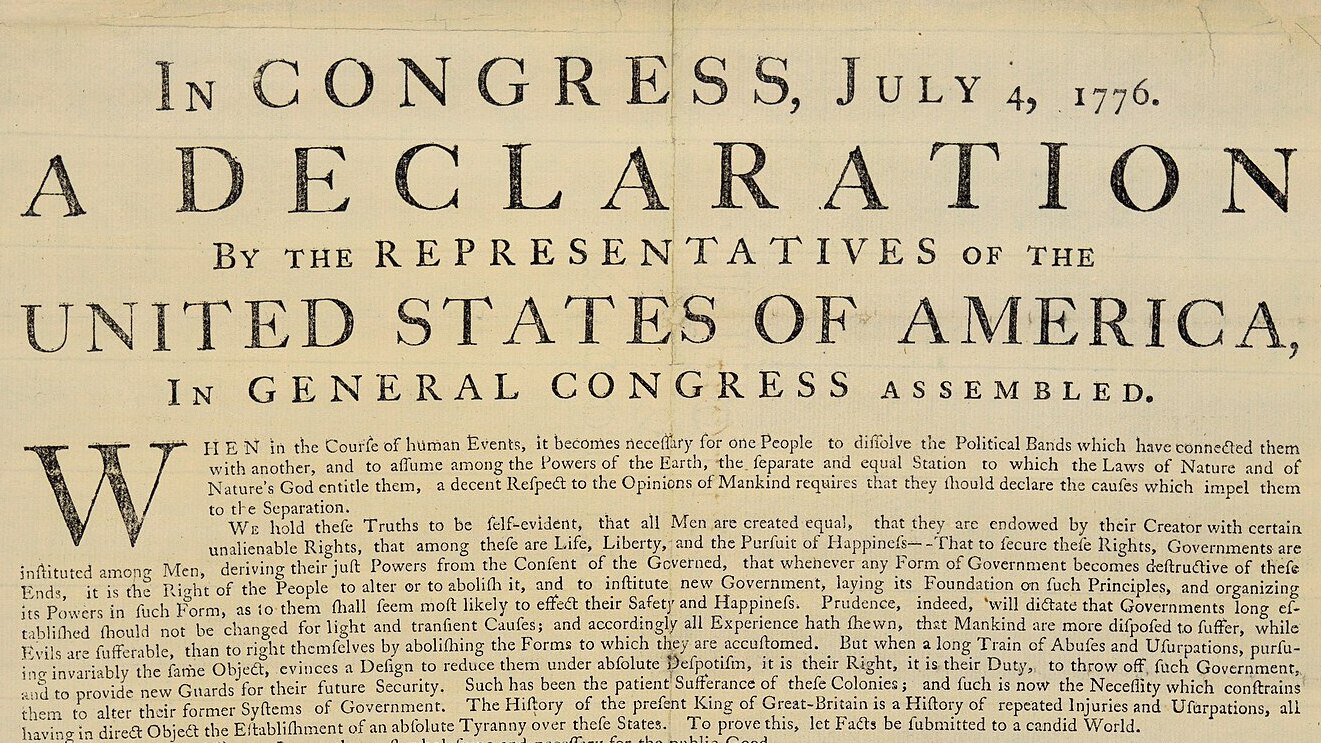
Chief Justice John Roberts is right: The Declaration of Independence, while not law itself, must be the benchmark that guides all three branches of government.
On New Year’s Eve, the Chief Justice released his annual year-end report on the state of the judiciary. Of particular note is the brief prefatory letter that Roberts has often used to opine on controversial issues such as judicial independence, artificial intelligence in the legal profession, and security threats against judges. This year’s letter focuses on the Declaration of Independence, which celebrates its 250th anniversary in 2026. While many commentators have criticized Roberts for “dodging” the biggest questions of the day—especially perceived favoritism for the Trump administration—his words are apt for the times, focusing on the foundational ideals that define the American experiment.
In 1776, the Declaration was a radical idea. It argued that the government, established by the consent of the governed, exists to secure the People’s unalienable rights, including life, liberty, and the pursuit of happiness. Today, these words have become seemingly trite phrases, so often used that they have lost the boldness and fortitude they possessed at the time. Yet it is crucial, as the Chief Justice recognizes, that our government return to these words and measure their efforts against them.
In the report, Roberts presents a reasoned and nuanced view of how the Declaration should inform the law. He first explains that the Declaration, unlike the Constitution or US Code, is not law itself. Moreover, while the Declaration’s aspirations shaped our government, it has repeatedly fallen short. Take, for instance, the phrase “all men are created equal.” The signers believed this to be a self-evident truth, yet most participated in slavery.
Despite its shortcomings, Roberts argues that the Declaration, even in its aspirational form, has served as a vital guidepost when the government has failed to protect rights. For example, Justice John Marshall Harlan invoked the Declaration in his Plessy v. Ferguson dissent, and civil rights leaders and suffragists turned to the document as the moral authority for their causes.
The Chief Justice’s letter serves as a reminder that the Declaration continues to hold practical importance. However, many commentators have mischaracterized the report as anomalous and evasive, claiming that it broke from tradition and sidestepped the public’s larger concerns about the judiciary.
These criticisms fail to recognize that Roberts frequently uses the year-end report to honor special events and anniversaries. For instance, in the 2021 edition, the Chief Justice wrote about the history and importance of the Judicial Conference. It would have been unusual for the High Court to ignore our country’s major milestone, especially in light of efforts by the other branches. To celebrate the Semiquincentennial, Congress established the America250 Commission to commemorate the signing of the Declaration. Similarly, President Trump created the “Salute to America 250 Task Force” and, on New Year’s Eve, lit up the Washington Monument with the “Illumination of America” display. Roberts’s latest letter lacks the pomp and circumstance of these other projects, yet it embodies the same spirit of reflection. Moreover, contrary to the critiques, his letter still endeavors to address, albeit subtly, the latest controversies through the lens of America’s Founding.
In the letter, Roberts marches through 250 years of history, focusing on principles with modern salience. His starting point is Thomas Paine’s “Common Sense” and the key formulation that the government’s purpose is not to serve the whims of the few, but of the People. This remains true today.
In a purposeful detour, he turns to the life of Samuel Chase, one of the Declaration’s signers, who was impeached by the House but acquitted in the Senate. At the time, many senators believed that it was improper to remove a judge from office based on disapproval of his decisions. A timely historical nod, given the Chief Justice’s rare public statement last year. Back in March, President Trump publicly called for Judge James Boasberg to be removed from the bench because he blocked the President’s deportation plans. As Roberts wrote, “impeachment is not an appropriate response to disagreement concerning a judicial decision. The normal appellate review process exists for that purpose.”
The Declaration belongs at the center of the year-end report. As Roberts rightfully concluded, it is the responsibility of all three branches of government to live up to the promises of the Declaration. These principles guide our legislators, executive officials, and especially our courts, and they are worthy of repetition.
The post The Declaration of Independence Is Still Our Guidepost was first published by the Foundation for Economic Education, and is republished here with permission. Please support their efforts.