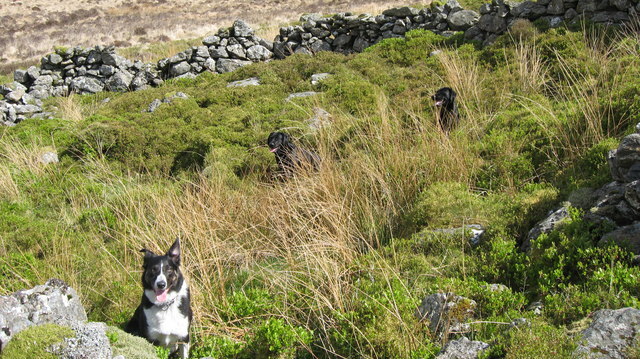
On the Isle of Lewis, crofters still work the old way: one man, two dogs, a flock and the Atlantic wind. Watching Leslie and his collies, Bruce and Jude, round up sheep across the moor, I was struck by how little command was needed. After a whistle and a word, Bruce and Jude’s instincts took care of the rest. It was order without control, and freedom within purpose. This is liberty properly understood.
Lewis is home to many traditional industries: crofting, tweed weaving and fishing. It is a place where life still depends on skill, community and respect for the elements. When Leslie led his dogs up the slope, the scene felt timeless—as if little had changed in hundreds of years. Yet what struck me most was not nostalgia, but what this simple working relationship revealed about freedom, trust and the limits of control.
Bruce and Jude know exactly what to do when faced with a stubborn or stray sheep. Leslie doesn’t bark a dozen new commands; he trusts their judgement. They read the terrain, sense the flock’s movement, and decide how best to bring order. It’s a partnership built on mutual understanding. The dogs aren’t free in the sense of doing whatever they please. Instead, they’re free within the bounds of purpose and discipline. Their obedience doesn’t crush their independence; it makes their independence possible.
That relationship holds a lesson far beyond the croft. Today, governments too often resemble over-anxious shepherds, issuing endless directives in an attempt to control every variable. If Leslie tried to script each move Bruce and Jude made, chaos would follow. They’d be confused, hesitant and paralysed by instruction. The croft would fall apart under the weight of micromanagement. The same is true in governance: when the state presumes it must command every detail of life, initiative disappears, trust erodes and competence declines.
The partnership between crofter and dog is a vivid example of order emerging from freedom, not imposed from above but grown from within. The dogs act through local knowledge: they understand their environment, the flock and the subtle cues of their master. They don’t need constant direction because the system they’re part of already carries shared norms and mutual trust. That is how real cooperation happens, not through regulation, but through relationship.
Liberty isn’t lawlessness. Bruce and Jude don’t dash off into the heather the moment Leslie’s whistle falls silent. Their freedom is earned—rooted in discipline, skill and trust. The same kind of freedom sustains the island itself. Across Lewis, you’ll find honesty boxes beside country roads, where locals leave fresh eggs, freshly baked goods and even second-hand tweed clothing with only a tin for payment. There’s no CCTV or bureaucracy, just trust that people will do the right thing. In addition, if a crofter falls ill, a neighbour will tend their flock. Responsibility here is personal, not outsourced to an agency or committee.
Life on the island runs on initiative and mutual respect, not official instruction. No one decreed that honesty boxes must exist, or that crofters must help one another. These customs endure because it worked in the past and still does now. That’s what gives Lewis its quiet strength: a sense that freedom is not a problem to be solved, but a condition to be sustained.
Compare that with the modern political impulse to regulate everything from speech to stove tops. Too often, policymakers assume that order must come from above—from central planners in Whitehall or Holyrood. Yet on the boggy hills of Lewis, order arises naturally from trust and shared purpose. The dogs don’t need a policy paper to know what to do. They need training, trust and space to act. The same is true for free people.
Freedom doesn’t mean chaos; it means responsibility and room to exercise it. The moors of Lewis quietly remind us that systems built on trust work better than those built on control. The more power that drifts upward to the state, the weaker those local bonds become. Freedom, once replaced by bureaucracy, rarely returns.
Watching Leslie, Bruce and Jude herd sheep against the Atlantic wind, it was easy to see why this relationship has endured for centuries. It’s efficient, humane and rooted in mutual understanding; a living metaphor for liberty. The crofter doesn’t need to dominate his dogs. Instead, he trusts them to do their work. That trust, once earned, becomes the foundation of order. And whether on the hillside or in society at large, that’s what freedom really should be: not the absence of structure, but the presence of trust.
This article originally ran at CapX.
The post Systems of Trust was first published by the Foundation for Economic Education, and is republished here with permission. Please support their efforts.