In Brussels, we have witnessed a scene that has become increasingly common: protests by European farmers marked by escalating hostility, including burning tires and clashes with police. This discontent is the cumulative reaction to a process that has dragged on for more than 25 years, and is now being pushed toward completion under conditions that are deeply damaging to European farmers.
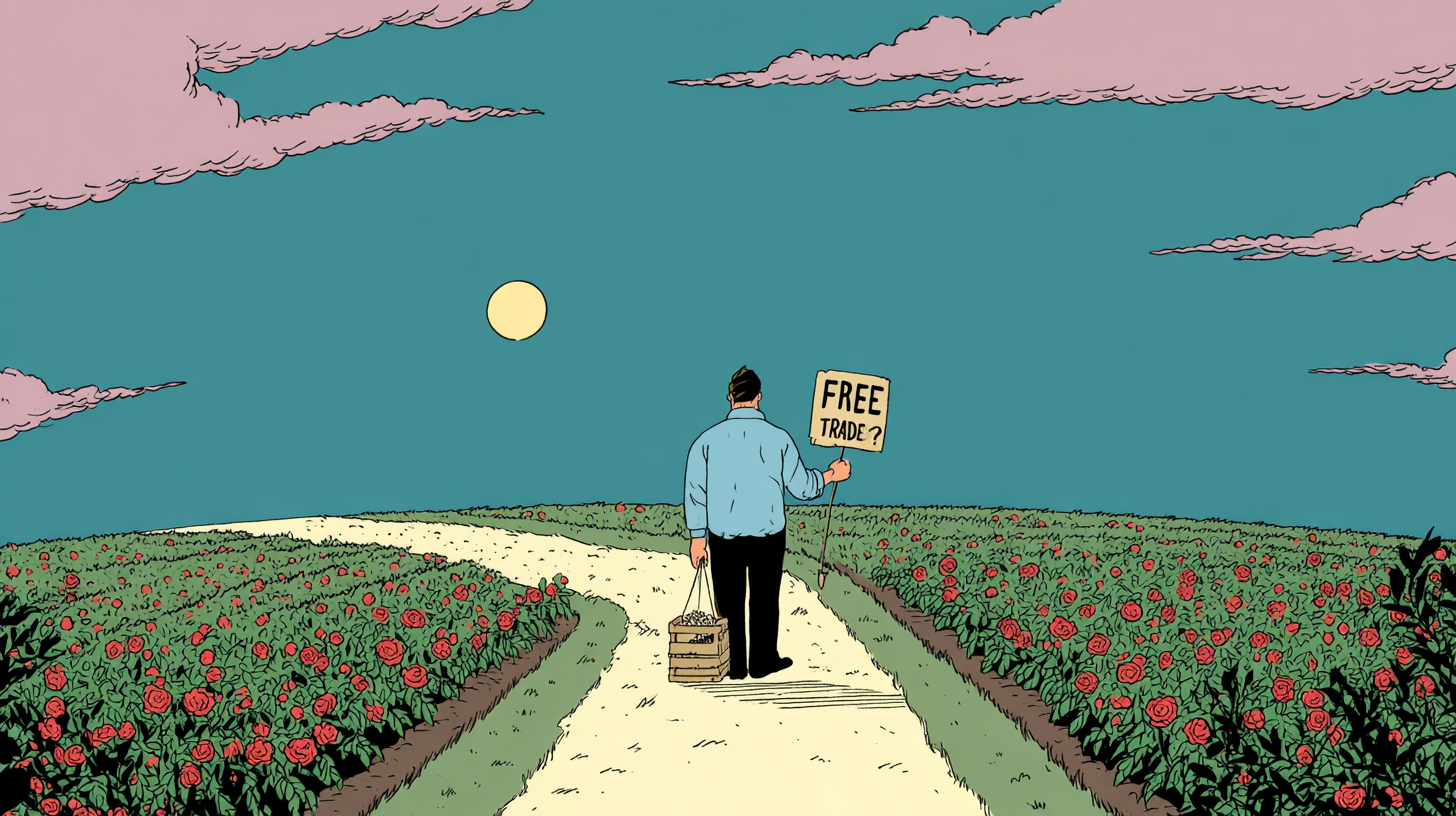
Some invoke the benefits of free markets, and, under normal circumstances, these do indeed offer the best outcomes for both producers and consumers. The problem is that between European farmers and producers from Mercosur—a trade bloc that includes Argentina, Bolivia, Brazil, Paraguay, and Uruguay—the market can never be truly free, because farmers in each bloc operate under fundamentally different regulatory conditions.
The European Union (EU) requires its farmers to comply with increasingly stringent environmental, sanitary, and labor standards under the European Green Deal and the Common Agricultural Policy (CAP)—including specific rules such as GAEC 8, which obliges farmers to leave portions of their land uncultivated as fallow areas or nonproductive features like hedgerows or biodiversity zones. These requirements significantly raise production costs. At the same time, the EU seeks to open its market to products from countries that are not subject to comparable rules and can sell at lower prices. Under these conditions, to speak of a “free market” is a conceptual error. There is no market freedom when costs are imposed asymmetrically by political decision.
In practice, this forces European farmers to give up part of their productive capacity in order to meet politically defined environmental objectives, without any proportional compensation in income and without equivalent obligations being imposed on imported products. This represents an indirect cost imposed by regulatory decisions. The farmer produces less, while continuing to compete in an open market with external producers who are not required to withdraw land from production.
The same applies to the severe restrictions on the use of pesticides and fertilizers imposed by the Farm to Fork strategy. European farmers are compelled to rely on alternative inputs that are often more expensive and operationally less effective, not because they fail environmental or ecological standards, but because they tend to provide narrower protection, require more frequent application, and function reliably only under specific agronomic conditions. This increases exposure to pests and crop disease, raises production costs, and makes yields more volatile, particularly for small farms.
Producers in Mercosur countries are not operating without regulation: These countries have their own environmental, sanitary, and labor rules, and agricultural exports to the European Union must comply with EU food safety standards at the border. However, these requirements are not comparable in scope or economic impact to the EU’s production-level constraints.
Under the Farm to Fork strategy, the EU has set targets to reduce pesticide use and risk by 50% and fertilizer use by at least 20% by 2030, implementing these goals through restrictions on inputs and bans on numerous active substances. Many substances prohibited in the EU, such as Chlorothalonil, remain authorized for agricultural use in Mercosur countries.
While Mercosur producers may be subject to national regulations and sustainability objectives, they are not required to internalize equivalent production-level constraints that systematically reduce output or raise compliance costs. As a result, European farmers face regulatory pressures that are not shared by their external competitors, creating an artificial price gap driven by regulatory asymmetry rather than differences in productive efficiency.
Added to these pressures are the costs associated with labor and social standards in force within the EU. European farmers must comply with high minimum wages, social security contributions, and strict rules governing hiring and workplace safety, at a time of severe agricultural labor shortages. These obligations are legitimate within an economic system that values social protection and workers’ rights. However, they become a source of distortion when the EU opens its market to products from countries where labor costs are substantially lower, regulations are less demanding, and enforcement is weaker. Once again, price differences do not reflect greater productive efficiency but a profoundly unequal regulatory framework.
At the same time, European farmers face an effective reduction in support under the CAP, as financial assistance is increasingly conditional on compliance with environmental requirements and administrative controls. Farmers who fail to meet these conditions risk losing income support. This model disproportionately affects small farmers, who lack the financial and administrative capacity to absorb additional costs, continuously adapt to new rules, and compete in a liberalized market without regulatory reciprocity.
More than a simple trade agreement, the EU–Mercosur dossier is becoming a source of division within the EU itself. The public opposition of French President Emmanuel Macron and the resistance of other member states with vulnerable agricultural sectors reveal deep differences among countries with divergent economic priorities. When an agreement places national governments under intense social pressure and forces member states to choose between preserving European unity and protecting internal stability, the issue ceases to be merely agricultural or commercial and becomes clearly political. Moving forward without correcting these inequalities risks worsening internal tensions and deepening public distrust in European institutions.
If the EU wishes to be honest about the concept of free markets and preserve its agricultural base, it must reduce the environmental, administrative, and social burdens imposed on its own farmers. Maintaining a system in which European producers are burdened with politically imposed costs while competing in an open global market is unsustainable. Continuing on this path will inevitably lead to the disappearance of small farmers, increased concentration of production, and greater dependence on foreign nations for food.
The post Brussels Bets the Farm was first published by the Foundation for Economic Education, and is republished here with permission. Please support their efforts.